Discovered in 1774 by English Captain Cook of New Caledonia became French territory in 1853 and will be built in separate colony in 1862. It represents in 1871 the land of exile for French Communists rose against the regime but also for the revolt Kabyle insurgents. This last place in 1871 , shortly after the events of the Paris Commune. The main causes of this uprising is the occupation of the country, but also arbitrary poverty, famine and dispossession of land by colons.Dirigée by Mohamed el Moqrani and extending to three quarters of the country, the insurrection ended with the trial court of the principal leaders of Constantine, whose brother El Moqrani "Boumezregue. The award is the destination of deportation to New Caledonia. Hundreds of insurgents were then exiled to the country's prisons, where they found the Parisian Communards but many die before reaching the island.
[http://www.acb54.com/IMG/jpg/portraitmok.jpg] Mokrani In 1864 Sheikh El Sheikh Mohammed El Mokrani Devaux General receives a reprimand because assistance he had given to Sheikh Bouakkaz ben Achour in 1864-1865 and was demoted in 1870 under bachagha, dignitaries of the administrative hierarchy. To overcome the famine settled in 1867 and then touches the countryside, he invests his own money and borrows many are at the Bank of Algeria and the Jewish Mesrine. But after the departure of the Military Governor General Mac Mahon in 1870 and the grip of power by the civil authorities, they refuse to honor the commitment of El Mokrani, and thus plunges into a financial crisis requiring to mortgage its assets. Moreover it perceives in the replacement of military rule by civilian authorities a way to establish the domination of European settlers on the Algerians. This, added to the proclamation of Cremieux decree of October 24, 1870 granting French citizenship to Jews and sent word to Sheikh "I'd rather be in a sword chop off my head but never under the leadership of a Jewish" strengthens sense of injustice and encourages them to revolt. He launched March 16, 1871 and the biggest uprising against the French colonial power.
The beginnings of the first phase of the insurgency in El Mokrani, sparked after he had presented to the second time he resigned from his post bachaga are marked by insurgencies in El Ahras Kablouti and Laghouat by Ben Chohra and Bouchoucha. The actual trigger is marked by the return to the Department of War bachaga his badge and held several meetings with men and senior officers. March 16, begins his advance towards the town of Bordj Bou Arreridj at the head of a troop estimated at seven thousand horsemen to put pressure on the colonial administration. The uprising eventually reaches Miliana Cherchell M'sila Boussaâda Touggourt, Biskra, Batna and Ain Salah. However, several disagreements arise within the family of El Mokrani. Faced with this situation it joins Sheikh Haddad, head of the Sufi Muslim brotherhood Rahmaniyya, proclaiming jihad against the settlers April 8, 1871. 145,000 men, from two hundred and fifty tribes are mobilized. But despite the mobilization capacity for combat disagreements resurface especially following the death of El Mokrani May 5, 1871 during the Battle of Wadi Souflat. These conflicts occur between Aziz, son of Cheikh El Haddad and Boumezrag brother of El Mokrani. The decline of the resistance is also linked to the conflict to zaouias (religious school) of Rahmaniyya. On October 8, 1871 Boumezrag goes to the Sahara. The French took the knowledge and stop January 20, 1872 at Ouargla. He was sent to prison in New Caledonia. April 19, 1873 Sheik El Haddad was sentenced to five years imprisonment but died ten days after his detention.
[http://www.vuici.com/images/carte-nouvelle-caledonie.gif] New Caledonia - Noumea Boumezrag After the arrest of the French army managed to end the insurgency. Then the awards fall. On 10 March 1873, the court opened the trial of Constantine the leaders of the insurgency: 149 of 212 defendants are sent to prison for 84 and the verdict is without appeal the deportation to New Caledonia. Among them include Aziz Ben Cheikh El Haddad. Moreover, the tribes involved in the insurgency are obliged to pay taxes according to the magnitude of their contribution to the uprising: 70 francs to anyone who has attracted the attention of the French administration, 140 francs to anyone s 'being mobilized and 210 francs to anyone who took part in combat and publicly stated his opposition to the colonial power. All refusal to pay is necessarily followed by a seizure of personal property. The deportation policy in New Caledonia was subsequently generalized to the population who actively participated in the insurgency. A total of 200,000 insurgents are then exiled to the country's prisons, where they found the Parisian Communards but many die before reaching the island. Jean Allemane cites the figure of two thirds of deaths in custody.
These newcomers, called the Kabyle Pacific, "will never see their pays.La voyage lasted five months and the prisoners were locked up in iron cages. Many inmates died of diseases such as phthisis, scurvy, gangrene or starvation, not claiming no medical care. The diary of Major Dubuquois doctor accurately describes travel conditions of the deportees "He voluntarily left to die", "1 405 people on board, 320 including 39 convicted Kabyle, on these there are 5 deaths. These fed improperly, he suffered and suffered rationing of inadequacy. On the Isle of Pines where they are held Kabyle insurgents alongside other insurgents, the Communards, which a close solidarity between them.
[http://www.chocolat.tv/photos/albums/userpics/10001/normal_bagnes-noumea.jpg] Exile Noumea Arrived in New Caledonia deportees are placed in prisons, which, established by Napoleon III; enable the provision of free labor and that populate the islands. The colonial convict convicts frighten designated in exile, torn from their country and their families. Inaugurated in 1864, the prison of New Caledonia is expected to accommodate prisoners in better conditions in Guyana: without diseases and climatic stress. However, the colony people forced march. A law is imposed; "the law of dubbing" a prisoner sentenced to less than eight years to double his exile staying the same number of years in the territory after its liberation. Beyond 8 years of pain, no return home is possible. Some prisoners
faring more cruel than their peers. The convicts are running almost all the hard labor of general interest, they built their own prison and infrastructure necessary for community living for urban planning. In Noumea, chained together, they perform the work of filling the city center, the exploitation of the forest, opening roads, draining swamps, carrying heavy loads until exhaustion. Strongest fulfill contracts "human flesh": hundreds of convicts are leased four times cheaper than free labor to dig in the mines for 20 years. Those sentenced to life imprisonment do not perform forced labor and are kept in tiny dark cells and humid. Men do not go out and never perceive the light of day. To use the free settlers, Governor Guillain creates the category of "assigned", composed of convicts to conduct satisfactory and authorized to work in private homes as "family boys" engaged in housework: ironing, laundry and kitchen. Other assigned are assigned to the administration of prison. The deportees
Kabyle experienced exactly the same fate as the French Communists, and so there was between them a sort of complicity. Its two categories of prisoners were completely opposite. They had nothing to compare historically, geographically and culturally speaking, but they were both animated by a sense of injustice and fought the French government in place and also known the same sentence, lock him away from theirs. This has enabled the reconciliation of all prisoners.
[http://www.brazza.culture.fr/img/afrique/iconos/la_politique_coloniale_en_afrique_apres_1879/la_politique_coloniale_en_afrique_apres_1879_32.jpg] President GambettaEn 1879, the Communards an amnesty following the struggle of many French intellectuals such as Victor Hugo, Emile Zola ... but this amnesty excludes Algerians. By restoring their country, the Communists launched an awareness on the subject of French Kabyle deported to the example Louise Michel and Henri Rochefort. The latter, moreover, after escaping in 1874, moved to Brussels and founded his newspaper, The Lantern, who devote much time to the cause of the deportees. This awareness is paying off. Thus, under pressure from the Left and French prisoners, the president decides Gambetta amnesty for all prisoners. It is noted that this has not prevented, by implication, it will not release the Paris Communards by diverting the law but with its latest release that the Algerians.
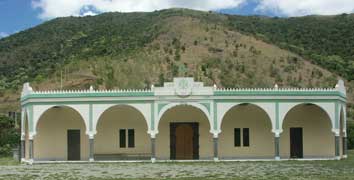
Once released, some returning to Algeria but others remain New Caledonia. One can be led to believe they did not choose to settle and they wanted to return too. For example, we try by all means retain Boumezrag, which still represents a threat and it would even entered the French army to carry out a crackdown, with fifty other Algerian soldiers against the rebellion of Caledonian minority, the Canaques.Aujourd Today, it still traces of its presence in the Pacific Kabyle. In fact, quite ready to Noumea, capital of Southern Province, is the "Valley of the Arabs" and not there away from the cemetery where the Arabs are buried former Algerian deportees. People are buried in the pure ritual Muslim graves facing Mecca. In addition to the cemetery, there are also people who try not to "forget" their culture and traditions. They speak indeed some Arabic words, are part of an association of Muslims in the region, they also have a mosque and a religious center where we celebrate all Muslim holidays. Upon entering the Nessadiou (Valley of Arabic), it's like being in a real village kabyle. [Http://www.amnc.org/images/bourail_long.jpg] Islamic Center of Nessadiou
Conclusion Thus, the insurrection against the French colonial power carried by El Mokrani extends across the north. Boumezrag after the arrest of the French army managed to stop the uprising and condemned the leaders of the resistance. The verdict led the Chiefs and then the people who participated in the insurrection in New Caledonia; sentenced to exile. Some 200,000 join the insurgents prisons after long and arduous journey. Throughout the trip, "Kabyle Pacific" are locked in cages and transported conditions awkward: many died of disease and starvation before reaching the island. Arrived in New Caledonia, they are placed in prisons. In addition they participate in the settlement of the archipelago by providing a large workforce used to build prisons and urbanize the area. Some are assigned, however, serve free settlers but the majority of detainees remain in prisons where they rub shoulders with the Parisian Communards. These two categories of insurgents united by a bond of solidarity reinforced by a sense of injustice and even expulsion. Thus, the amnesty enjoy the French Communards lead by the grace of suitela Kabyle insurgents.
Célia.A, Célia.C, Sara.C, Malik.H SOURCES: • http://www.seddouk-ouffella.com/spip.php?article108 • http:// www.planet-dz.com/ACTU/2001/mai/lallaoui-algeriens-du-pacifique.htm • http://www.editions-berberes.com/article.php3?id_article=64 • http://nouvellecaledonie.rfo.fr/ • http://www.vitaminedz.com/articles-169-0-721-toute_l_algerie-histoire___07__l_occupation_francaise-histoire__les_algeriens_de_nouvelle_caledonie_-3.html
• http://www.algerie-dz.com/article1019.html
• http://www.makabylie.info/?article1245
• http://www.amnc.org/amnc/algeriens.php
• http://fr.wikipedia.org/wiki/Kabyles_du_Pacifique
• http://www.amnc.org/images/bourail_long.jpg • http://www.brazza.culture.fr/img/afrique/iconos/la_politique_coloniale_en_afrique_apres_1879/la_politique_coloniale_en_afrique_apres_1879_32.jpg • http://www.acb54.com/IMG/jpg/portraitmok.jpg • http://www.vuici.com/images/carte-nouvelle-caledonie.gif • http://www.chocolat.tv/photos/albums/userpics/10001/normal_bagnes-noumea.jpg • Mehdi Lallaoui, Kabyle Pacific, 1994 Edition On behalf of the memory, Bezons, France • History of Algeria CDROM published by the Department of the Mujahideen
[http://www.acb54.com/IMG/jpg/portraitmok.jpg] Mokrani In 1864 Sheikh El Sheikh Mohammed El Mokrani Devaux General receives a reprimand because assistance he had given to Sheikh Bouakkaz ben Achour in 1864-1865 and was demoted in 1870 under bachagha, dignitaries of the administrative hierarchy. To overcome the famine settled in 1867 and then touches the countryside, he invests his own money and borrows many are at the Bank of Algeria and the Jewish Mesrine. But after the departure of the Military Governor General Mac Mahon in 1870 and the grip of power by the civil authorities, they refuse to honor the commitment of El Mokrani, and thus plunges into a financial crisis requiring to mortgage its assets. Moreover it perceives in the replacement of military rule by civilian authorities a way to establish the domination of European settlers on the Algerians. This, added to the proclamation of Cremieux decree of October 24, 1870 granting French citizenship to Jews and sent word to Sheikh "I'd rather be in a sword chop off my head but never under the leadership of a Jewish" strengthens sense of injustice and encourages them to revolt. He launched March 16, 1871 and the biggest uprising against the French colonial power.
The beginnings of the first phase of the insurgency in El Mokrani, sparked after he had presented to the second time he resigned from his post bachaga are marked by insurgencies in El Ahras Kablouti and Laghouat by Ben Chohra and Bouchoucha. The actual trigger is marked by the return to the Department of War bachaga his badge and held several meetings with men and senior officers. March 16, begins his advance towards the town of Bordj Bou Arreridj at the head of a troop estimated at seven thousand horsemen to put pressure on the colonial administration. The uprising eventually reaches Miliana Cherchell M'sila Boussaâda Touggourt, Biskra, Batna and Ain Salah. However, several disagreements arise within the family of El Mokrani. Faced with this situation it joins Sheikh Haddad, head of the Sufi Muslim brotherhood Rahmaniyya, proclaiming jihad against the settlers April 8, 1871. 145,000 men, from two hundred and fifty tribes are mobilized. But despite the mobilization capacity for combat disagreements resurface especially following the death of El Mokrani May 5, 1871 during the Battle of Wadi Souflat. These conflicts occur between Aziz, son of Cheikh El Haddad and Boumezrag brother of El Mokrani. The decline of the resistance is also linked to the conflict to zaouias (religious school) of Rahmaniyya. On October 8, 1871 Boumezrag goes to the Sahara. The French took the knowledge and stop January 20, 1872 at Ouargla. He was sent to prison in New Caledonia. April 19, 1873 Sheik El Haddad was sentenced to five years imprisonment but died ten days after his detention.
[http://www.vuici.com/images/carte-nouvelle-caledonie.gif] New Caledonia - Noumea Boumezrag After the arrest of the French army managed to end the insurgency. Then the awards fall. On 10 March 1873, the court opened the trial of Constantine the leaders of the insurgency: 149 of 212 defendants are sent to prison for 84 and the verdict is without appeal the deportation to New Caledonia. Among them include Aziz Ben Cheikh El Haddad. Moreover, the tribes involved in the insurgency are obliged to pay taxes according to the magnitude of their contribution to the uprising: 70 francs to anyone who has attracted the attention of the French administration, 140 francs to anyone s 'being mobilized and 210 francs to anyone who took part in combat and publicly stated his opposition to the colonial power. All refusal to pay is necessarily followed by a seizure of personal property. The deportation policy in New Caledonia was subsequently generalized to the population who actively participated in the insurgency. A total of 200,000 insurgents are then exiled to the country's prisons, where they found the Parisian Communards but many die before reaching the island. Jean Allemane cites the figure of two thirds of deaths in custody.
These newcomers, called the Kabyle Pacific, "will never see their pays.La voyage lasted five months and the prisoners were locked up in iron cages. Many inmates died of diseases such as phthisis, scurvy, gangrene or starvation, not claiming no medical care. The diary of Major Dubuquois doctor accurately describes travel conditions of the deportees "He voluntarily left to die", "1 405 people on board, 320 including 39 convicted Kabyle, on these there are 5 deaths. These fed improperly, he suffered and suffered rationing of inadequacy. On the Isle of Pines where they are held Kabyle insurgents alongside other insurgents, the Communards, which a close solidarity between them.
[http://www.chocolat.tv/photos/albums/userpics/10001/normal_bagnes-noumea.jpg] Exile Noumea Arrived in New Caledonia deportees are placed in prisons, which, established by Napoleon III; enable the provision of free labor and that populate the islands. The colonial convict convicts frighten designated in exile, torn from their country and their families. Inaugurated in 1864, the prison of New Caledonia is expected to accommodate prisoners in better conditions in Guyana: without diseases and climatic stress. However, the colony people forced march. A law is imposed; "the law of dubbing" a prisoner sentenced to less than eight years to double his exile staying the same number of years in the territory after its liberation. Beyond 8 years of pain, no return home is possible. Some prisoners
faring more cruel than their peers. The convicts are running almost all the hard labor of general interest, they built their own prison and infrastructure necessary for community living for urban planning. In Noumea, chained together, they perform the work of filling the city center, the exploitation of the forest, opening roads, draining swamps, carrying heavy loads until exhaustion. Strongest fulfill contracts "human flesh": hundreds of convicts are leased four times cheaper than free labor to dig in the mines for 20 years. Those sentenced to life imprisonment do not perform forced labor and are kept in tiny dark cells and humid. Men do not go out and never perceive the light of day. To use the free settlers, Governor Guillain creates the category of "assigned", composed of convicts to conduct satisfactory and authorized to work in private homes as "family boys" engaged in housework: ironing, laundry and kitchen. Other assigned are assigned to the administration of prison. The deportees
Kabyle experienced exactly the same fate as the French Communists, and so there was between them a sort of complicity. Its two categories of prisoners were completely opposite. They had nothing to compare historically, geographically and culturally speaking, but they were both animated by a sense of injustice and fought the French government in place and also known the same sentence, lock him away from theirs. This has enabled the reconciliation of all prisoners.
[http://www.brazza.culture.fr/img/afrique/iconos/la_politique_coloniale_en_afrique_apres_1879/la_politique_coloniale_en_afrique_apres_1879_32.jpg] President GambettaEn 1879, the Communards an amnesty following the struggle of many French intellectuals such as Victor Hugo, Emile Zola ... but this amnesty excludes Algerians. By restoring their country, the Communists launched an awareness on the subject of French Kabyle deported to the example Louise Michel and Henri Rochefort. The latter, moreover, after escaping in 1874, moved to Brussels and founded his newspaper, The Lantern, who devote much time to the cause of the deportees. This awareness is paying off. Thus, under pressure from the Left and French prisoners, the president decides Gambetta amnesty for all prisoners. It is noted that this has not prevented, by implication, it will not release the Paris Communards by diverting the law but with its latest release that the Algerians.
Once released, some returning to Algeria but others remain New Caledonia. One can be led to believe they did not choose to settle and they wanted to return too. For example, we try by all means retain Boumezrag, which still represents a threat and it would even entered the French army to carry out a crackdown, with fifty other Algerian soldiers against the rebellion of Caledonian minority, the Canaques.Aujourd Today, it still traces of its presence in the Pacific Kabyle. In fact, quite ready to Noumea, capital of Southern Province, is the "Valley of the Arabs" and not there away from the cemetery where the Arabs are buried former Algerian deportees. People are buried in the pure ritual Muslim graves facing Mecca. In addition to the cemetery, there are also people who try not to "forget" their culture and traditions. They speak indeed some Arabic words, are part of an association of Muslims in the region, they also have a mosque and a religious center where we celebrate all Muslim holidays. Upon entering the Nessadiou (Valley of Arabic), it's like being in a real village kabyle. [Http://www.amnc.org/images/bourail_long.jpg] Islamic Center of Nessadiou
Conclusion Thus, the insurrection against the French colonial power carried by El Mokrani extends across the north. Boumezrag after the arrest of the French army managed to stop the uprising and condemned the leaders of the resistance. The verdict led the Chiefs and then the people who participated in the insurrection in New Caledonia; sentenced to exile. Some 200,000 join the insurgents prisons after long and arduous journey. Throughout the trip, "Kabyle Pacific" are locked in cages and transported conditions awkward: many died of disease and starvation before reaching the island. Arrived in New Caledonia, they are placed in prisons. In addition they participate in the settlement of the archipelago by providing a large workforce used to build prisons and urbanize the area. Some are assigned, however, serve free settlers but the majority of detainees remain in prisons where they rub shoulders with the Parisian Communards. These two categories of insurgents united by a bond of solidarity reinforced by a sense of injustice and even expulsion. Thus, the amnesty enjoy the French Communards lead by the grace of suitela Kabyle insurgents.
Célia.A, Célia.C, Sara.C, Malik.H SOURCES: • http://www.seddouk-ouffella.com/spip.php?article108 • http:// www.planet-dz.com/ACTU/2001/mai/lallaoui-algeriens-du-pacifique.htm • http://www.editions-berberes.com/article.php3?id_article=64 • http://nouvellecaledonie.rfo.fr/ • http://www.vitaminedz.com/articles-169-0-721-toute_l_algerie-histoire___07__l_occupation_francaise-histoire__les_algeriens_de_nouvelle_caledonie_-3.html
• http://www.algerie-dz.com/article1019.html
• http://www.makabylie.info/?article1245
• http://www.amnc.org/amnc/algeriens.php
• http://fr.wikipedia.org/wiki/Kabyles_du_Pacifique
• http://www.amnc.org/images/bourail_long.jpg • http://www.brazza.culture.fr/img/afrique/iconos/la_politique_coloniale_en_afrique_apres_1879/la_politique_coloniale_en_afrique_apres_1879_32.jpg • http://www.acb54.com/IMG/jpg/portraitmok.jpg • http://www.vuici.com/images/carte-nouvelle-caledonie.gif • http://www.chocolat.tv/photos/albums/userpics/10001/normal_bagnes-noumea.jpg • Mehdi Lallaoui, Kabyle Pacific, 1994 Edition On behalf of the memory, Bezons, France • History of Algeria CDROM published by the Department of the Mujahideen